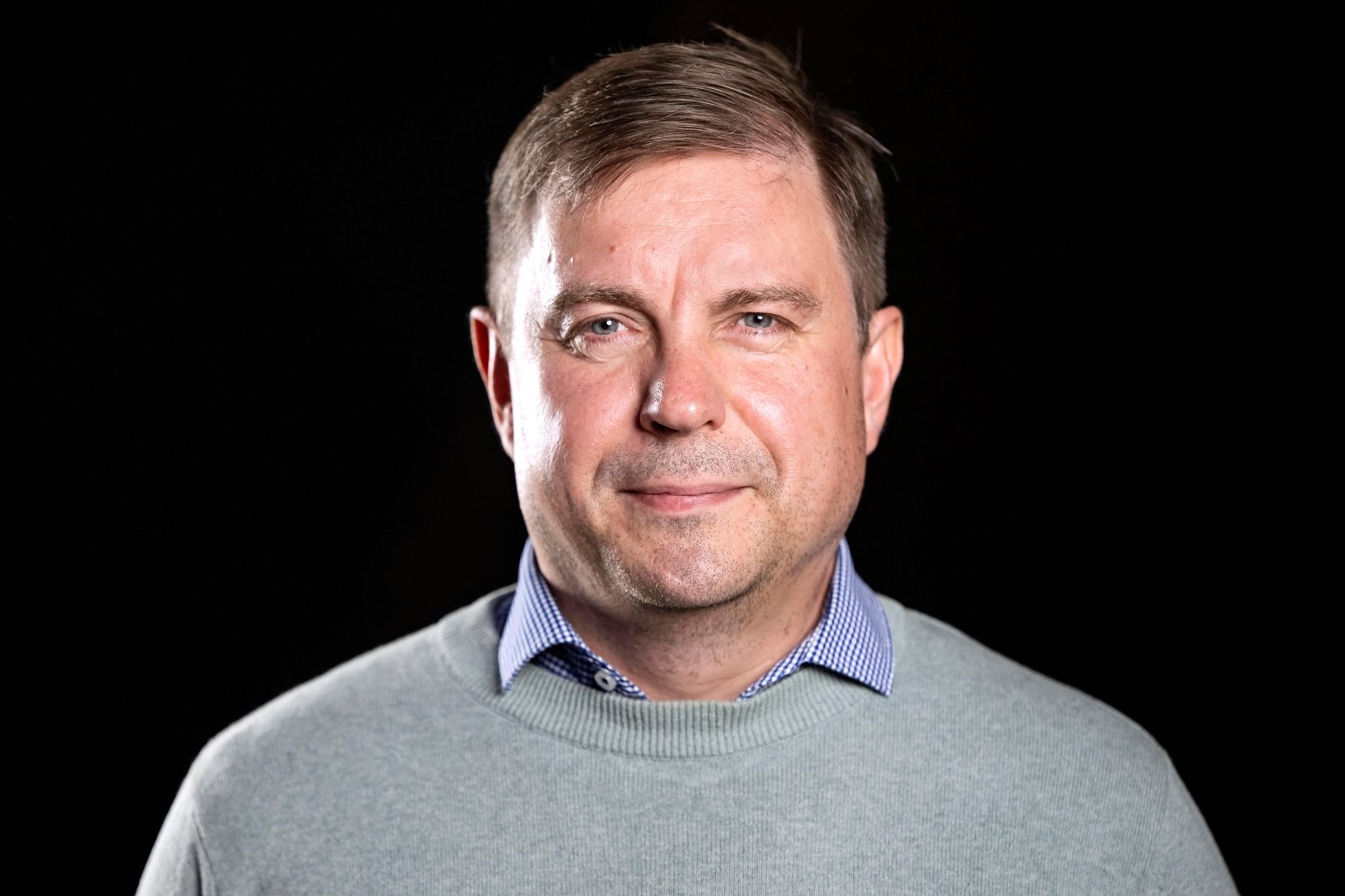
Sergei Lebedev receives the 2027 Erich Loest Prize.
Leipzig, 30 September 2026. Sergej Lebedew is awarded the 2027 Erich Loest Prize from Media Foundation of Sparkasse Leipzig. Established in memory of the Leipzig writer and honorary citizen Erich Loest - who passed away on 12 September 12 2013 - the prize carries a cash award of 10,000 euros and is being presented for the seventh time. The award ceremony will take place on 24 February 2027 - Erich Loest’s birthday - at the Villa Ida Media Campus in Leipzig.
"Sergei Lebedev is one of the most distinguished figures in contemporary Russian literature," explains Stephan Seeger, Managing Director of Media Foundation and Director Foundations of Sparkasse Leipzig. "His books focus primarily on the legacy of the Soviet Union - and specifically the impact that its history of violence continues to have on life in present-day Russia. In his latest novel, 'The Guardian' ('Die Beschützerin'), he finds a powerful metaphor for this against the backdrop of Russia’s war of aggression against Ukraine," Seeger adds. This novel was also central to the decision made by the award jury, chaired by Andreas Platthaus. "With this novel, the jury honors a work of linguistic virtuosity - a story of guilt and repression, of old and new horrors, of rage and powerlessness - that is grounded in the philosophy of history yet possesses a prophetic, contemporary relevance. In doing so, the jury has once again made an outstanding and well-considered choice, for which I am deeply grateful. I congratulate our new Erich Loest Prize laureate, Sergei Lebedev, on this richly deserved honour," Seeger continues.
The jury explained its choice of Lebedew as follows: "Sergei Lebedew is a master of time shafts, a geologist of literature. His subject matter is the eruption of the past, which (…) seeks to dominate the present. (…) Sergei Lebedew is a poetic figure among the ruins who exposes himself to the reverberations of what has been denied, creates spaces of linguistic depth, interprets European landscapes of violence as if they were scenes in a mirror, and commits himself to a language of memory." (The full statement from the jury can be found at the end of this announcement.)
In addition to the chair, Andreas Platthaus (Head of the Literature and Literary Life section at the Frankfurter Allgemeine Zeitung), the jury included Ulrika Rinke (Program Director of the Literaturhaus Rostock), Linde Rotta (freelance writer), Ines Geipel (writer, Professor of the Art of Verse at the "Ernst Busch" Academy of Dramatic Arts in Berlin, and 2023 Erich Loest Prize winner), and Professor Jobst Welge (Professor of Romance Literature at Leipzig University).
About the Erich Loest Prize:
The prize, endowed with 10,000 euros, has been awarded by Media Foundation of Sparkasse Leipzig since 2017 in memory of the writer Erich Loest. It is generally presented on a biennial basis. Throughout his life, Erich Loest maintained close ties to the Sparkasse foundations - serving as a founding member of Media Foundation and as a patron of the Cultural and Environmental Foundation, to which he bequeathed his literary estate. The award honours authors who do not merely describe social and political conditions in Germany but also actively help shape democratic discourse through their voices. In addition, recipients are expected to have a connection to the Central German region. Previous recipients include Guntram Vesper (2017), Hans Joachim Schädlich (2019), Ulrike Almut Sandig (2021), Ines Geipel (2023), Ronya Othmann (2025), and Durs Grünbein (2026).
About the laureate:
Sergei Lebedev was born in Moscow in 1981. Following in his parents' footsteps, he studied geology and spent eight years working as a field geologist on expeditions in Russia's far north and in Central Asia. Lebedev has also worked as a journalist since 2001, focusing on historical and educational policy issues. He writes investigative reports, commentaries, and essays for media outlets worldwide, including the Neue Zürcher Zeitung, Liberties, Osteuropa, and the Washington Post.
Since 2010, Sergei Lebedev has published six novels that examine - from various perspectives - the hidden Soviet past, the impact of Stalin’s repressions, and their consequences for modern life in Russia. Four of his novels draw upon his own family history: "The Sky on Your Shoulders" (2013), "The Year of the Comet" (2013), "People in August" (2015), and "Children of Kronos" (2018) form a meta-novel that sheds light on the totalitarian trauma left behind by the Soviet Union. His fifth novel, "The Perfect Poison" (2021), is an intellectual thriller set in the shadowy world of Russian intelligence agencies and their operations abroad. In 2025, he published "The Protector", which depicts the early stages of Russian aggression against Ukraine in 2014.
In 2022, Lebedev was a co-organizer and signatory of an open letter from the Russian art scene opposing Russia's invasion of Ukraine. In 2025, he compiled the anthology "No", which brings together the voices of 25 Russian artists and intellectuals speaking out against the war in Ukraine.
Lebedev's books have been translated into 24 languages and shortlisted for major Russian and European literary prizes.
Sergej Lebedew has been living in Potsdam since September 2018. He writes in Russian, English, and German.
The full statement from the jury:
Sergei Lebedev is a master of temporal shafts, a geologist of literature. His subject matter is the eruption of the past - which, as the novel 'The Guardian' puts it, seeks to dominate the present in a state of being 'arranged, mixed, and intertwined.' A central image in the text is the concrete plug sealing the echo sounder of violence. While the Soviets might well wish to remove it to expose German crimes to the public, doing so would risk revealing their own atrocities as well. Consequently, the plug remains in place, sealed shut. Lebedev writes: 'There is a fundamental lack of will to dismantle the imperial-chauvinist matrix of consciousness.'
Shattering this matrix renders his books a singular study in shadows. That which was denied or forgotten - the poison of the past - returns, claiming an abyssal afterlife. It is as if the voices in Lebedev’s books were ceaselessly wandering through their own ghostly realms. While some choose silence and repression, others are compelled to bear witness, confronting the horror with their own testimony. Born in Moscow in 1981 and now living in Potsdam, Sergei Lebedev is a poetic chronicler of ruins; he exposes himself to the reverberations of what has been denied, creates spaces of linguistic depth, interprets European landscapes of violence as if they were scenes in a mirror, and commits himself to the language of memory. In honouring Sergei Lebedev’s novel 'The Guardian', the Erich Loest Prize jury recognizes a work of linguistic virtuosity - woven from guilt and repression, old and new horrors, rage and powerlessness - that is grounded in the philosophy of history yet possesses a prophetic, urgent relevance.