






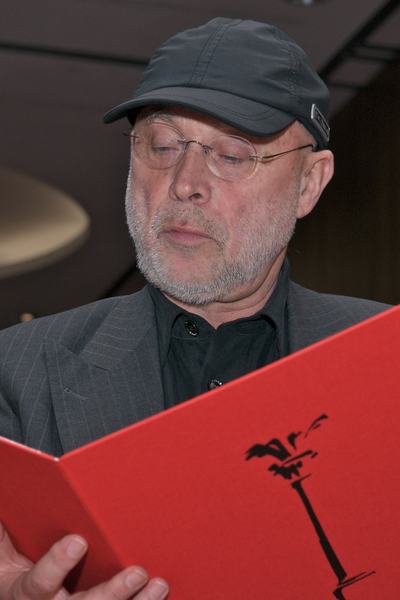
Hermann Bohlen, born in 1963 in Celle, studied Sinology in Hamburg, Berlin, and Shanghai between 1986 and 1992. He began creating radio plays during his university years and has worked as an independent radio drama producer since 1995. Bohlen’s early works, such as Gekaut!! (Bis es von alleine herunterläuft) (1990) and Die Wauwautheorie (1995), play with the sounds of language and demonstrate a 'pataphysical' interest in the philosophy of language. Gekaut!! portrays the life reformer Horace Fletcher using a constructed language composed of German, Low German, English, Chinese, and French, while Die Wauwautheorie explores the subject of onomatopoeia.
With Prozedur 7.7.0 (1996), Bohlen - following in the tradition of Orson Welles’s War of the Worlds, which was staged as a radio reportage - employs the "found-audio" radio play format as a form of artifice. The piece presents a world in which individuals who refuse to communicate are implanted with transponder chips for identification purposes. As is the case with many of his radio plays, the cast consists exclusively of non-professional actors. In Sag doch auch mal was or Das Luxurieren der Bastarde (1998), Bohlen assembles private audio recordings - discovered at flea markets and elsewhere - to construct a 50-minute panorama of a transitional era, caught between the slowly fading memory of war and the gradual emergence of pop culture. He employs a similar approach in Onager (2004), though here he focuses on more intimate, chamber-drama-like scenarios. While all his works since Prozedur 7.7.0 had been improvised based on the author’s instructions, Gräser fliegen nur noch selten (2005) marked a return to the use of a formal production script. The Süddeutsche Zeitung described this radio play as "the high point of his work to date". In 2000, Hermann Bohlen conceived and presented the Plopp competition for independent radio play creators at the Berlin Academy of Arts (Akademie der Künste), of which he became a member in 2009.
Hermann Bohlen’s radio plays have received numerous awards, including the Academy of Arts Radio Play Prize in 1997, the ARD German Radio Play Prize in 2012, and the German Audio Story Prize in the category of "Innovative or Artistic Radio Play" (formerly the War-Blinded Radio Play Prize).