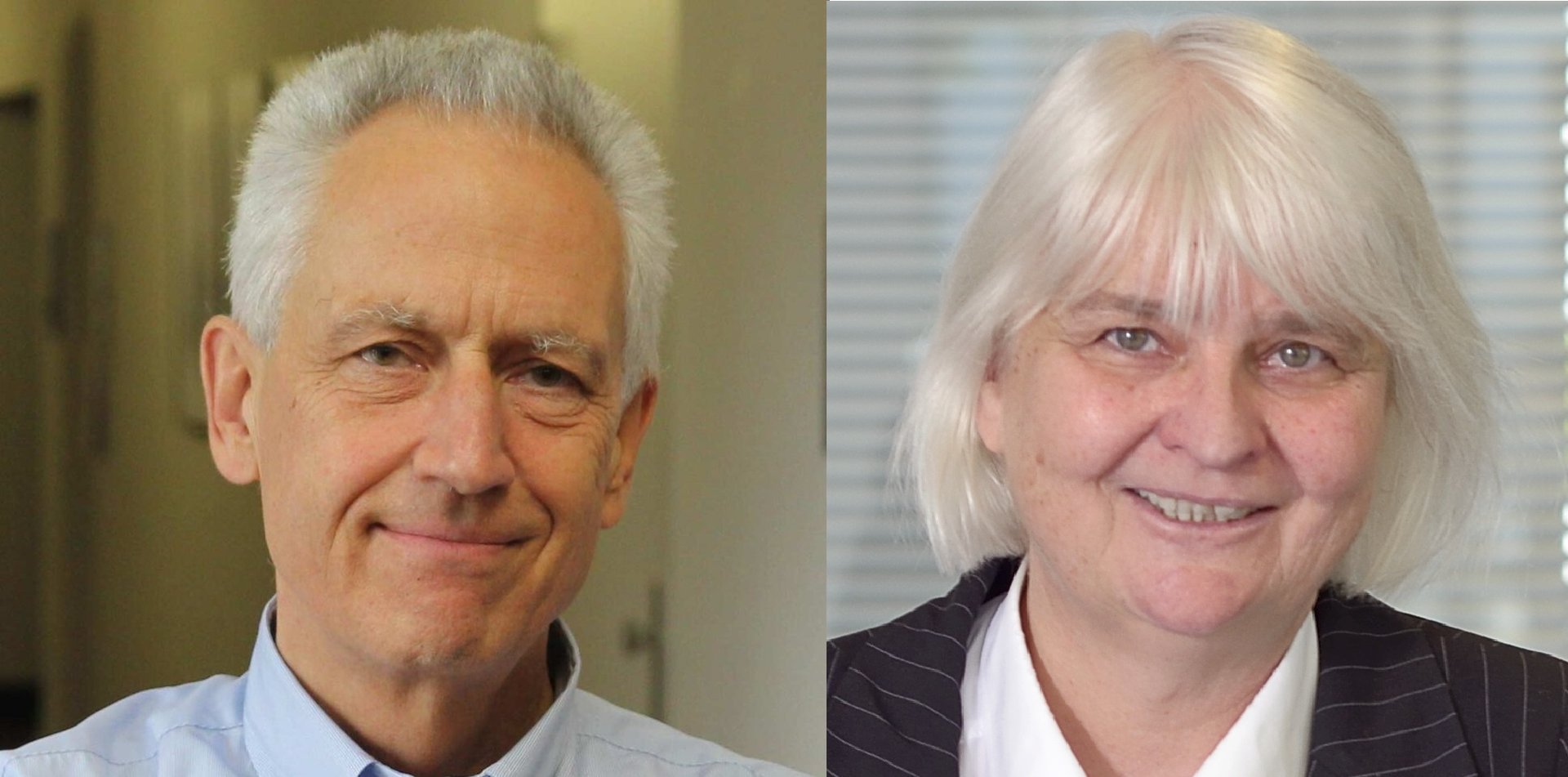
Professor Michael Haller is stepping down as head of the institute. Professor Gabriele Hooffacker will become the new Scientific Director on 1 May.
Leipzig, 7 April 2026: The European Institute for Journalism and Communication Research (EIJC) will have new leadership starting in May. Professor Gabriele Hooffacker - who served as Deputy Director of the Institute for Digital Teaching and Learning at HTWK Leipzig until July 2025 - succeeds Professor Michael Haller. Haller had led the research institute as Scientific Director since its founding in 2003 and is stepping down due to retirement.
"Over the past two-plus decades, Professor Michael Haller has done outstanding work at the EIJC," explains Stephan Seeger, Managing Director of Media Foundation of Sparkasse Leipzig, which supports the EIJC through institutional funding and by providing premises at the foundation's headquarters. "He has succeeded in establishing the EIJC within the academic community - extending well beyond Germany - through educational programs on media literacy and numerous studies on practical journalism research, while also strengthening the institute by actively fostering the next generation of scholars," Seeger adds.
"The transformation of the media landscape driven by digitalization and the Internet is unsettling large segments of the population," explains Michael Haller. For this reason, he considers it particularly important "to highlight the role of journalism in a democracy and to develop new educational materials for the school system to foster information and media literacy." Under his leadership, the comprehensive training program "Fit for news" was created. The incoming institute director, Professor Hooffacker, says: "The EIJC is ideally positioned to bring together Leipzig’s vibrant, dynamic media scene and academic research in media and communication studies. I am very much looking forward to this task!"
Gabriele Hooffacker will set the initial thematic tone with the kick-off event for the Leipzig Media Talks on 29 April, 2026, at Media Campus Villa Ida. Experts from academia and journalism will discuss "strategies against online hate."
About Professor Gabriele Hooffacker
Professor Gabriele Hooffacker, born in Munich in 1959, studied German studies, history, and economics at Ludwig Maximilian University of Munich. She earned her doctorate in 1986 with a thesis on 17th-century single-sheet prints; during this time, she worked for the *Monumenta Germaniae Historica*. In 1999, she founded the Munich Journalists' Academy (*Münchner Journalistenakademie*), offering courses and seminars on online journalism - which she directed until 2013 - and in 2008, she established the Journalists' Academy Foundation (*Stiftung Journalistenakademie*). As a journalist, she has worked for online portals, trade journals, and consumer magazines, and has published more than 50 non-fiction books on journalism, media, and the internet.
In 2013, Hooffacker accepted a professorship at the Leipzig University of Applied Sciences (HTWK Leipzig). From 2019 to 2025, she served as Deputy Director of the Institute for Digital Teaching and Learning at HTWK Leipzig, an institute she co-founded. As Dean of Studies, she oversaw several degree programs, most recently the new Bachelor’s program in Media Production. From 2020 to 2025, she was a member of the HTWK University Council.
Gabriele Hooffacker is a member of the German Communication Association (DGPuK) and serves on the jury for the Alternative Media Prize. Since 2018, she has co-edited the open-access journal *Journalistik - Zeitschrift für Journalismusforschung* alongside Horst Pöttker and others. She is the editor of the *Journalistische Praxis* series on journalism (Springer VS).
About Professor Michael Haller
Professor Michael Haller, born in Konstanz in 1945, studied philosophy, social sciences, and political science in Freiburg and Basel; he earned his doctorate with a thesis on Hegel’s political philosophy (*System und Gesellschaft*) and gained extensive journalistic experience as a senior editor at several regional newspapers. His career was significantly shaped by his time as a reporter for *Der Spiegel* - where he served on the editorial staff for over a decade - and for *Die Zeit*, where he headed the "Dossier" section for several years. In addition, he lectured at the University of Zurich and taught the theory and practice of journalism at journalism academies and training centers. He has been a member of the German Communication Association (DGPuK) since that time.
In early 1993, Haller was appointed to the professorship of General and Specialized Journalism at the University of Leipzig. He held the Chair of Journalism from 1994 until his retirement in 2010. Since then, he has advised media editorial teams and served on the boards of institutions dedicated to journalism training, both in Germany and abroad. Since 2018, he has been an elected member of the Leibniz Society of Sciences in Berlin. In addition to numerous publications in media studies regarding the role of journalism in open information societies, Haller was the founding editor of the international journalism journal *message* and editor of the book series *Leipziger Journalismus*. As the author of several textbooks, he established fundamental standards for practical journalism.
Since its founding in 2003, Michael Haller has also served as Scientific Director of the EIJC.
About the Institute
The EIJC was founded in 2003 as the Institute for Practical Journalism Research (IPJ) - at the initiative of Media Foundation of Sparkasse Leipzig and the University of Leipzig’s Chair of Journalism - as a joint project between the university and the foundation, with support from Sparkassenversicherung Sachsen. Since 2011, it has operated as an independent non-profit research institution under the umbrella of Media Foundation.
In 2014, the institute was restructured as the European Institute for Journalism and Communication Research. Since then, the focus has been placed particularly on the role of media and journalism in Western Europe. The institute examines social information structures and processes, as well as normative questions regarding media freedom and journalistic independence. Its scholarly work aims to contribute to international discourse through interdisciplinary research, empirical studies, and practice-oriented projects. The findings are intended to strengthen public understanding of the media and foster constructive discussion regarding issues of journalistic quality.
The EIJC is organized as a non-profit association, supported by Media Foundation through the provision of premises at Villa Ida and institutional funding.
More can be found at www.eijc.de
Leipzig Media Talks
Starting this year, EIJC and Media Foundation of Sparkasse Leipzig are launching the Leipzig Media Talks. These talks serve as a forum for discussion and the sharing of media knowledge and media literacy on an equal footing. The target audience includes professionals in journalism and the media, educators, and those in schools, universities, politics, and public administration, as well as students and volunteers.
In a discussion format featuring two to four participants, topics of public interest concerning journalism and media are explored with experts - primarily from Saxony - and presented to a broader audience.
The first Leipzig Media Talk on 29 April 2026, focuses entirely on "strategies to combat online hate." What are the causes of the increasingly harsh tone on online platforms - a hostility directed particularly at journalists? Is it due to the frequently cited societal divide, or are there other factors at play? Above all, what measures are effective - both in the short and long term? This inaugural event presents approaches and concepts regarding how journalism deals with online hate and discusses which strategies might prove successful.
- Where?: Media Campus Villa Ida, Poetenweg 28, 04155 Leipzig
- When: Wednesday, 29 April, 2026, 6 p.m.
- Doors open at 5:15 p.m.; bar open for drinks.
Free admission; please register by 27 April at 0341-5629662 or m.fiedler@mitteldeutsches-stiftungsmanagement.de.
On the panel:
- Professor Stine Eckert, Associate Professor at Department of Communication of Wayne State University, Detroit
- Dr. Judith Kretzschmar, Research Associate at the Centre for Journalism and Democracy at Leipzig University
- Professor Michael Haller, European Institute for Journalism and Communication Research (EIJC), Leipzig
- Michael Krell, research associate at TU Dresden university and freelance writer for *Die Zeit* covering right-wing extremism.
Moderation:
Professor Gabriele Hooffacker, Leipzig University of Applied Sciences (HTWK)