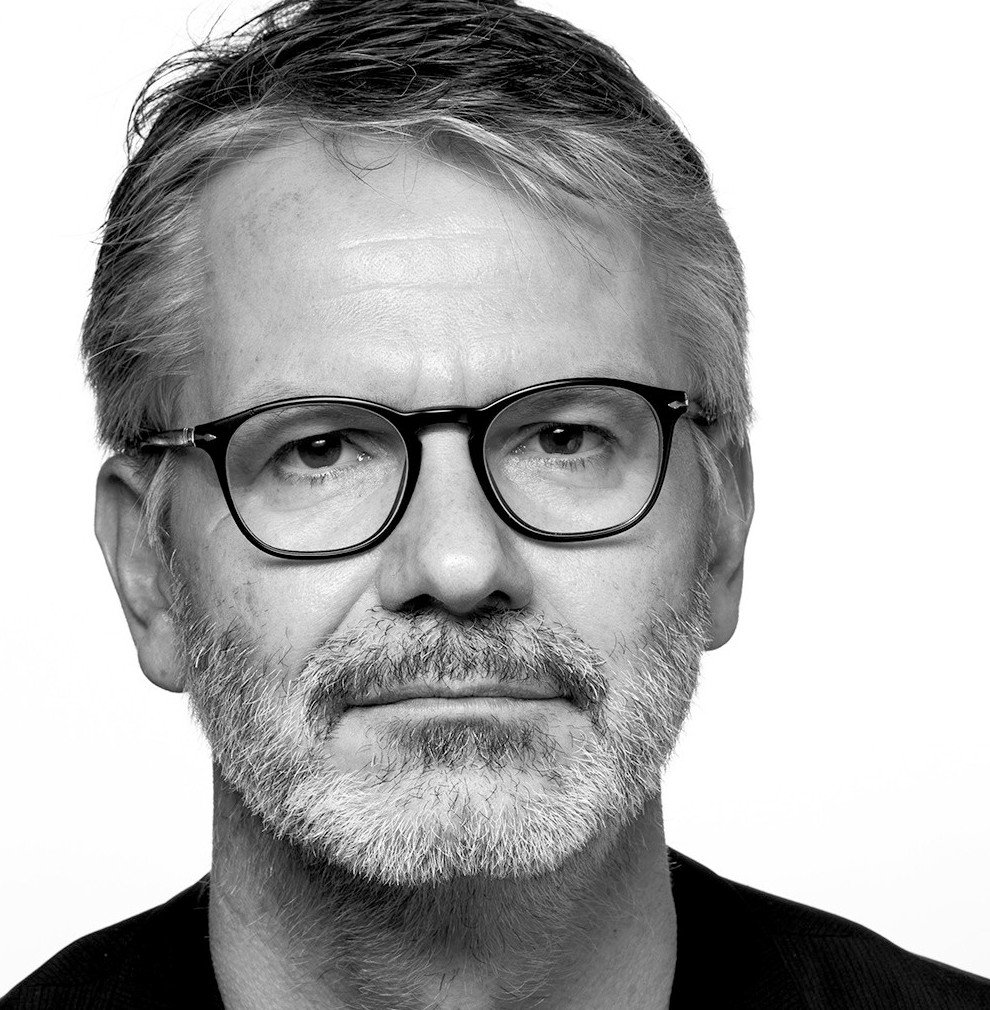
Erich Loest Prize 2026 awarded to Durs Grünbein
Leipzig, 26 November 2025. To mark the 100th anniversary of Erich Loest's birth on 24 February 2026, Media Foundation of Sparkasse Leipzig will award the 2026 Erich Loest Prize. The jury has awarded the prize to the writer and Georg Büchner Prize winner Durs Grünbein. The prize, established by Media Foundation of Sparkasse Leipzig in memory of the Leipzig based writer and honorary citizen Erich Loest, who died on 12 September 2013, is endowed with 10,000 euros and is being awarded for the sixth time. The award ceremony for Durs Grünbein will take place on 24 February 2026, at Media Campus Villa Ida in Leipzig. The laudatory speech will be given by former German President Joachim Gauck.
“The significance of Durs Grünbein as a contemporary author is evident from the fact that he received the Georg Büchner Prize for his literary work at the young age of 33,” explains Stephan Seeger, Managing Director of Media Foundation and Director Foundations of Sparkasse Leipzig. “The jury focused primarily on Grünbein’s recent prose work in their decision and made an outstanding choice that Erich Loest would have more than agreed with. I extend my warmest thanks to the jury and congratulate our new Erich Loest Prize winner, Durs Grünbein, on this well-deserved award.”
The jury, chaired by Andreas Platthaus, honours Grünbein as an author of narrative and essayistic prose that addresses (auto)biographical themes against the backdrop of German history, highlighting in particular the works "Die Jahre im Zoo" ("Years in the Zoo", 2017), "Jenseits der Literatur" ("Beyond Literature", 2020), and "Der Komet" ("The Comet", 2023). The jury's statement reads: "Grünbein explores the interplay of language, photographs, memory, and fiction in relation to the trauma of the destruction of his birthplace, Dresden, as well as the mechanisms of totalitarian rule and the history of violence in the 20th century. Grünbein's perspective on his own and others', often marginalized, life stories, on the material and psychological traces of the past, is never solely historically oriented, but rather emerges from the perspective of someone who also considers the uncertainties of remembering and keenly reflects on the political upheavals and poisons of the present." Grünbein shows "in the sense of Loest and with the means of a sensual, unsentimental and communicative language [...] that freedom and the awareness of the presence of history are linked."
The Jury
- Andreas Platthaus (Chair of the Jury; Head of Literature and Literary Life Department of Frankfurter Allgemeine Zeitung)
- Linde Rotta (freelance author)
- Ines Geipel (writer and professor of versification at the Berlin University of the Arts "Ernst Busch" and 2023 laureate of Erich Loest Prize)
- Dr Katrin Schumacher (Head of Literature, Film, and Stage at MDR Kultur radio)
- Professor Jobst Welge (Professor of Romance Literature at Leipzig University)
About the laureate
Durs Grünbein was born in Dresden in 1962. In 1985, he moved to East Berlin and began studying theater studies. He abandoned his studies in 1987 and decided to pursue writing. He studied quantum physics and neurology autodidactically, as well as philosophy, including the works of Ludwig Wittgenstein, the Frankfurt School, and the French structuralists. Grünbein also contributed to various magazines, exhibitions, and publishing projects.
Grünbein's first volume of poetry, "Grauzone morgens" ("Gray Zone in the Morning"), was published by Suhrkamp publisher in 1988. The texts, written between 1985 and 1988, offer a stark and authentic snapshot of life in the urban centers of East Germany. This was followed in 1991 by the highly acclaimed volume "Schädelbasislektion" ("Skull Base Lesson"), whose cycles of poems address the period before, during, and after the fall of the Berlin Wall. In "Falten und Fallen" ("Folds and Fallen") (1994), Grünbein continues his poetic concept of analytical lyric poetry situated between language and the physical.
In the poetry collections of the following years, Grünbein increasingly sought formal and thematic dialogue with great poets of world literature. For example, "Vom Schnee" ("About Snow", 2003) is a portrait of the philosopher René Descartes in the form of an epic poem. Influenced by his stay in Rome as a fellow at the Villa Massimo, "Aroma - Ein römisches Zeichenbuch" ("Aroma - A Roman Book of Drawings", 2009) emerged as a kaleidoscope of poems and prose images. His twelfth poetry collection, "Äquidistanz" ("Equidistance"), was published in 2022. His first novel, "Komet" ("Comet"), was released in 2023.
Grünbein also published several collections of essays, numerous catalogue entries, an opera libretto, and new translations of ancient plays. His work has been translated into several languages. In 1995, Grünbein received the "Peter Huchel Prize" for poetry and, as the youngest author to date, the "Georg Büchner Prize". In 2003, he became the first non-philosopher to be awarded the "Friedrich Nietzsche Prize". In 2009, he received the "Grand Cross of the Order of Merit" of the Federal Republic of Germany. Durs Grünbein is a member of the Academy of Arts, Berlin; the German Academy for Language and Literature; the Free Academy of Arts, Hamburg; the Free Academy of Arts, Leipzig; and the Saxon Academy of Arts. Since 2005, he has been Professor of Poetics at the Düsseldorf Art Academy, and since 2008, a member of the Order Pour le Mérite for Sciences and Arts in Berlin. Grünbein lives in Rome and Berlin.
About the Prize
The 10,000 euro prize has been awarded by Media Foundation of Sparkasse Leipzig in memory of the author Erich Loest since 2017. Normally, the prize is awarded every two years. This rule is being broken with an additional award ceremony to mark the 100th anniversary of Erich Loest's birth in 2026. Throughout his life, Erich Loest maintained close ties with the Sparkasse Foundations - as a founding member of Media Foundation and as a patron of Cultural and Environmental Foundation, to which he bequeathed his literary estate. The prize honours authors who not only describe the social and political conditions in Germany but also contribute to the democratic discourse with their voices. Furthermore, recipients should have a connection to Central Germany. Previous winners include Guntram Vesper (2017), Hans Joachim Schädlich (2019), Ulrike Almut Sandig (2021), Ines Geipel (2023), and Ronya Othmann (2025).